
Yuval Avidani
Author
The Open Source Answer to AI Coding Agents
The project OpenCode (https://github.com/anomalyco/opencode) solves the problem of vendor lock-in in AI-assisted coding. When Anthropic launched Claude Code recently, it set a new benchmark for what AI coding agents can do. But like most commercial tools, it locks you into their API, their pricing, and their terms. OpenCode is the community's response - an open source, terminal-based coding agent that works with any model you want.
This matters because we're at an inflection point. AI coding assistants are becoming essential tools, not optional extras. Choosing which one to adopt is like choosing your IDE or programming language - it shapes how you work every day. Being locked into one vendor's ecosystem is risky when the technology is evolving this fast.
The Problem We All Know
Here's what happens with current AI coding tools: You start using one service, maybe GitHub Copilot or Claude or Cursor. It works great for a while. Then you hit a wall. Maybe it's rate limits. Maybe the model gets worse after an update. Maybe you're working on sensitive code that legally cannot leave your infrastructure. Maybe you just want to try a different model for a specific task because you know GPT-4 is better at X while Claude is better at Y.
But switching tools means learning new interfaces, new commands, new workflows. Copilot lives in your editor. Claude lives in a chat window. Other tools want you to copy-paste code back and forth. You end up with five browser tabs open, three terminal windows, and you've lost track of which AI you asked what question. Your flow is completely broken.
The existing solutions don't solve this because they're all trying to own the entire stack. Each company wants you locked into their ecosystem because that's how they make money. Nobody is building the universal interface that lets you bring your own model.
How It Works
OpenCode runs as a client-server architecture (meaning one part handles the interface, another part talks to the AI models) with a Terminal User Interface or TUI (a text-based interface that runs in your command line but looks polished with colors and layouts). You install it, point it at whatever model you want to use, and it becomes your coding assistant right in your terminal where you already spend most of your time.
The agent understands your codebase through LSP support. LSP stands for Language Server Protocol - it's the same technology that powers autocomplete and error detection in VS Code. This means OpenCode can see your entire project structure, understand dependencies between files, and know what functions and classes exist where. It's not just reading text files - it understands code.
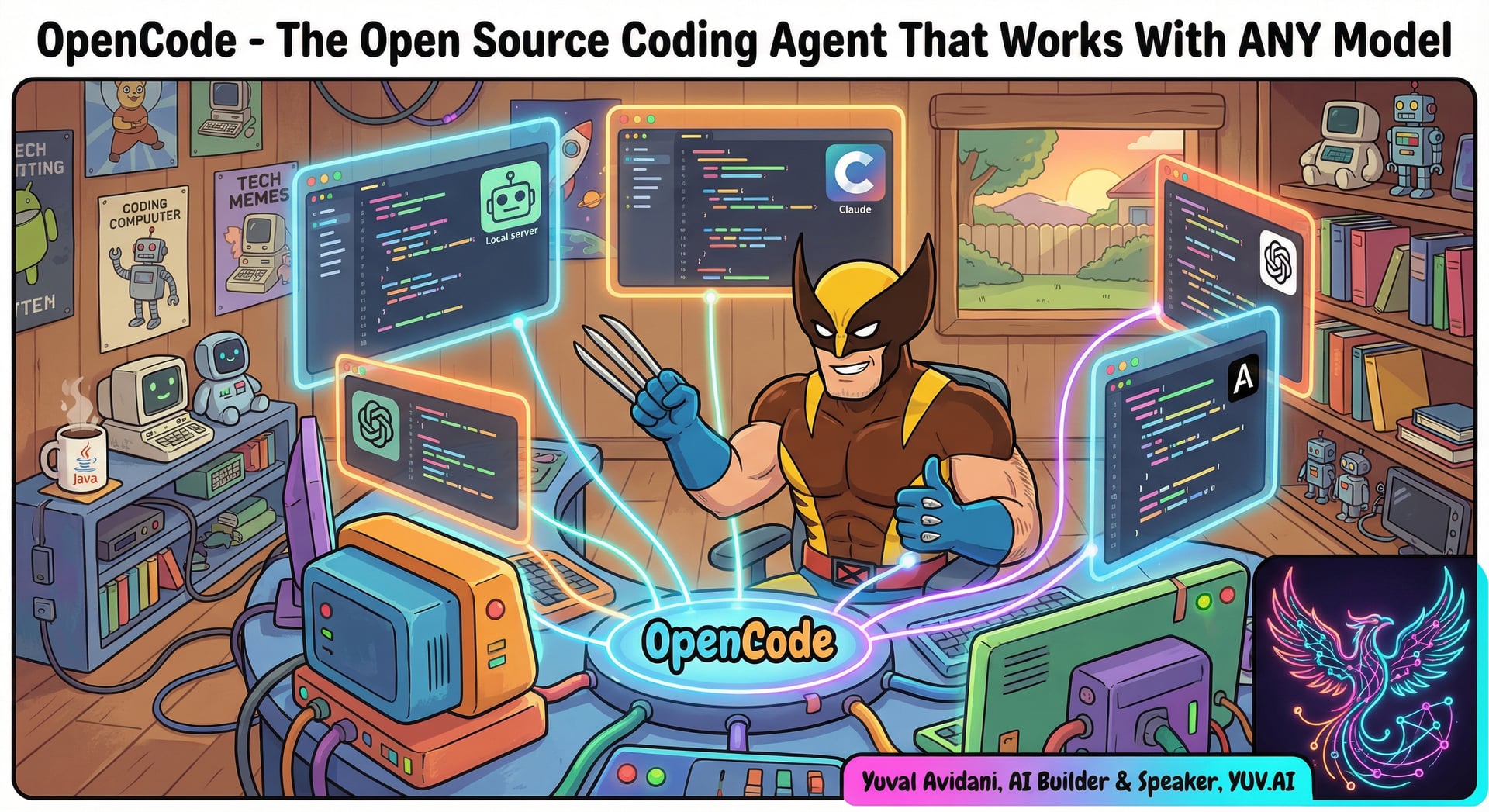
Here's the key difference: OpenCode is provider-agnostic (works with any service) and model-agnostic (works with any AI). You can connect it to Claude through Anthropic's API. Or OpenAI's GPT models. Or Google's Gemini. Or you can run a local model using Ollama or LM Studio on your own hardware. Same tool, same commands, different brain doing the thinking.
Think of it like this: OpenCode is the steering wheel and pedals, but you choose which engine to put in the car. Sometimes you want the race car engine (Claude Opus for complex reasoning). Sometimes you want the efficient hybrid (GPT-4 for speed and cost). Sometimes you want the engine you built yourself in your garage (local models for privacy). The controls stay the same - you just swap the engine.
The agent can edit files directly, execute terminal commands, and handle multi-step tasks autonomously. You tell it what you want to accomplish, and it breaks that down into steps: analyze the codebase, identify which files to change, write the code, test it, fix bugs it finds. You're not micro-managing every step.
Use Case Examples
Example one: You're building a new feature and you need to refactor how your API handles authentication. You could manually trace through six files to understand the current flow, figure out what needs to change, update each file, then test it. Or you tell OpenCode: "Refactor the auth system to use JWT tokens instead of session cookies." It scans your codebase, identifies every file that touches authentication, plans the changes, makes them, and shows you the diff. You review and approve. What would take you two hours takes fifteen minutes.
Example two: You're working on a client project with strict data privacy requirements. You cannot send their code to OpenAI or Anthropic or any cloud service. With OpenCode, you deploy a local model using Ollama (a tool for running AI models on your own machine), point OpenCode at that local endpoint, and now you have AI assistance that never leaves your laptop. The model isn't as powerful as Claude Opus, but it's infinitely better than coding without any AI help.
Example three: You're debugging a weird bug that only happens in production. GPT-4 is better at analyzing logs and finding edge cases, while Claude is better at understanding complex business logic. With OpenCode, you can switch models mid-conversation. Start with GPT-4 to analyze the error logs and narrow down the problem. Then switch to Claude to understand the complicated state management code where the bug lives. You get the best tool for each part of the job without leaving your terminal.
Why This Is Different from Claude Code and Copilot
Claude Code from Anthropic is incredible - it's what proved that AI agents in the terminal can actually work well. But it only works with Claude models. You're on Anthropic's pricing, Anthropic's rate limits, and Anthropic's terms. If they change their API or increase prices or decide to deprecate features, you're stuck.
GitHub Copilot lives in your code editor and is fantastic for autocomplete and small snippets. But it's not an autonomous agent that can handle complex multi-file changes. It's more like a really smart autocomplete than a pair programmer.
Cursor is closer - it's an entire AI-powered IDE. But again, you're tied to their model choices and their interface. If you prefer working in the terminal (like many DevOps engineers and backend developers do), Cursor doesn't help you.
OpenCode sits in a different space: terminal-native (for developers who live in the CLI), provider-agnostic (bring your own model), and open source (you can read the code, modify it, and deploy it however you want). You'd choose OpenCode over Claude Code when you need flexibility or privacy. You'd choose OpenCode over Copilot when you need autonomous multi-step tasks, not just autocomplete. You'd choose Claude Code over OpenCode when you want the most polished experience and don't mind vendor lock-in.
My Take - Should You Use This?
In my opinion, this is one of the most important projects in the AI coding tools space right now. Not because it's technically perfect - it's newer and probably has bugs. But because it represents what the ecosystem needs: interoperability and user choice.
OpenCode is perfect for teams that need data privacy (run local models), for developers who want to experiment with different models without switching tools, and for anyone who's nervous about betting their workflow on one company's API staying affordable and available.
The limitations are real though. Local models are still way behind Claude Opus or GPT-4 in capability. The project is younger than commercial alternatives, so expect some rough edges. And you need to be comfortable in the terminal - if you prefer graphical IDEs, this might not fit your workflow.
But here's the thing: every major shift in developer tools started with an open source project that gave developers freedom from vendor control. Git beat SVN. VS Code beat proprietary IDEs. Kubernetes beat proprietary orchestration. OpenCode might be the start of that same pattern for AI coding agents.
Check out the repo and try it on a side project: https://github.com/anomalyco/opencode. In my view, even if you stick with Claude Code or Copilot for now, keeping an eye on OpenCode is smart. This is where the open source community is heading.