
Yuval Avidani
Author
AI Agents Finally Get Portable Memory Without Infrastructure Bloat
The project Memvid solves the problem of giving AI agents persistent, evolving memory without forcing developers to deploy and manage separate vector database servers. It's a single-file memory layer written in Rust that packages everything an agent needs to remember into one portable file.
Why this matters to all of us building AI agents: we're tired of the infrastructure tax. Every time you want your chatbot to remember previous conversations or your agent to learn from past interactions, you end up deploying Pinecone, Weaviate, Chroma with a separate server, or some other vector database solution. That means API keys, cloud costs, network latency, and debugging nightmares when something goes wrong.
The Problem We All Know
AI models are stateless by design. The moment a conversation ends, they forget everything. GPT-4 doesn't remember what you told it yesterday. Claude doesn't know about your last session. This is fine for one-off queries, but it's a disaster for agents that need to evolve, learn, and build context over time.
The standard solution is RAG (Retrieval-Augmented Generation) - you store conversation history and relevant documents in a vector database, then retrieve relevant chunks when needed. But this introduces massive complexity. You need to run a vector database server (either locally or in the cloud), manage embeddings, handle API rate limits, worry about data synchronization, and debug black-box memory states when your agent behaves strangely. For a simple agent that just needs to remember user preferences or past interactions, this feels absurdly over-engineered.
Existing tools like LangChain with FAISS or Chroma help, but they still require separate processes, configuration files, and dependencies. Your agent can't just "carry its memory" with it. You can't easily version control the agent's learned knowledge. And when debugging, you can't rewind to see exactly what the agent "knew" at a specific point in time.
How Memvid Works
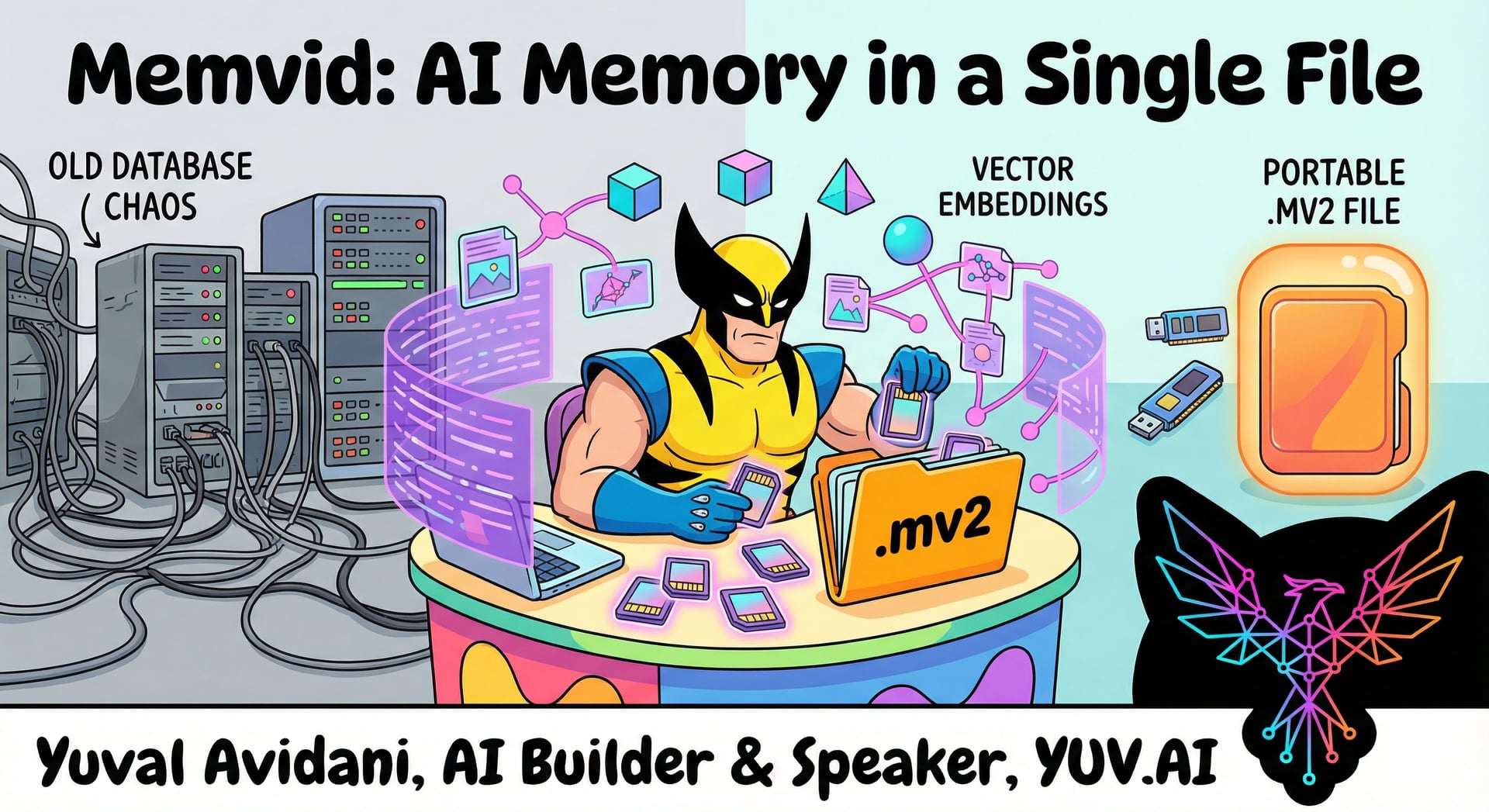
Memvid takes a radically different approach inspired by video codecs and databases like SQLite. It packages data, embeddings (vector representations of text that capture semantic meaning), search structures, and metadata into a single
.mv2
file. Think of it like SQLite - a complete database in one file you can copy, email, or version control - but designed specifically for AI memory instead of relational data.
The architecture uses an "append-only" model. Every memory update creates a new immutable "Smart Frame" (borrowing terminology from video encoding). This means the memory file grows over time but never modifies past entries. Why does this matter? Because it enables time-travel debugging. You can rewind the agent's memory to any previous state and see exactly what it "knew" when it made a specific decision. If your agent gave a weird answer on Tuesday, you can replay its memory state from Tuesday and understand why.
Memvid supports both full-text search and vector similarity search simultaneously within the same file. When your agent needs to recall something, it can search by keywords (like traditional database queries) or by semantic similarity (finding conceptually related memories even if the exact words differ). It works entirely offline - no API calls to external services, no cloud dependencies, no network latency.
The single-file design means your agent's entire memory is portable. You can copy the
.mv2
file between machines, back it up with normal file backup tools, put it in Git LFS for versioning, or even distribute it with your agent application. The agent literally carries its learned knowledge with it.
Use Case Examples
Imagine you're building a personal assistant chatbot that learns user preferences over time. Instead of deploying a Pinecone account and managing API keys, you initialize a Memvid file when the user first runs your app. Every conversation, every learned preference ("I prefer Python over JavaScript", "I'm working on a computer vision project") gets appended to this file. When the user reinstalls your app on a new device, they just copy their
.mv2
file and all their history comes with them. No cloud sync, no database migration scripts.
Or consider a code review agent that learns your team's coding standards. Each time it reviews a pull request and gets feedback ("we use single quotes, not double quotes"), that feedback becomes a memory. Over weeks, the agent builds up a rich understanding of your team's preferences. The entire learned knowledge base is in one file that you can commit to your monorepo. New team members can clone the repo and immediately get an agent that knows your standards.
For researchers and tinkerers, the time-travel debugging is invaluable. You can experiment with different prompting strategies, rewind the memory to a checkpoint, try a different approach, and compare outcomes. You can A/B test agent behavior by branching memory states - literally like Git branches, but for learned knowledge.
Why This Is Different from Pinecone/Weaviate/Chroma
Traditional vector databases like Pinecone and Weaviate are built for production scale - millions of vectors, multiple users, distributed systems. They're excellent when you need that scale, but they're overkill for most agent applications. Memvid trades scale for simplicity. You wouldn't use Memvid to power search for a million-user SaaS product, but you absolutely would use it for a personal agent, a research prototype, or any application where the agent's memory fits comfortably in one file (which is most agents).
Chroma and FAISS are closer competitors - they can run locally. But they still require separate processes and configuration. Memvid's single-file design means zero configuration. You point to a file path and you're done. And unlike FAISS, Memvid includes built-in full-text search, metadata filtering, and time-travel debugging.
You'd choose Memvid when you want simplicity, portability, and offline operation. You'd choose traditional vector databases when you need multi-user scale, distributed deployment, or want a fully managed cloud service. The beauty is that Memvid's file format could potentially be uploaded to a vector database later if you outgrow it - it's not a lock-in decision.
My Take - Should You Use This?
In my view, Memvid is exactly what the AI agent ecosystem needs right now. We've been over-engineering memory solutions because that's what we had available. But most agents don't need Pinecone-scale infrastructure. They need something as simple as SQLite was for databases - one file, zero configuration, works anywhere.
This is perfect for local AI agents, desktop applications, research prototypes, or any scenario where you want your agent to have memory without deploying cloud infrastructure. I'm absolutely using this for my next agent project instead of spinning up yet another vector database instance. The time-travel debugging alone is worth it - being able to see exactly what the agent knew at any point is a massive debugging superpower.
The main limitation is that it's still actively developing. The project is relatively new, and if you want deep integration, you'll need to be comfortable working with Rust bindings (though language bindings for Python and other languages are likely coming). Also, this isn't for massive-scale production systems - if you're building a multi-tenant SaaS with millions of users, you still want a distributed vector database.
But for 80% of agent use cases - personal assistants, research tools, desktop apps, internal company agents - this is a better solution than what we've been doing. Check it out: Memvid on GitHub. Finally, AI agents can have memory without the infrastructure tax.