
Yuval Avidani
Author
AI Agents Finally Get a Memory That Doesn't Require a PhD
The project Memvid solves the fundamental problem of giving AI agents long-term memory without forcing developers to become database administrators. It's a revolutionary "memory layer" that packages everything - data, embeddings, and metadata - into a single portable file.
Why this matters to all of us building AI applications: we've been stuck between giving our agents amnesia after every conversation or drowning in the complexity of vector databases and RAG infrastructure. Memvid offers a third path that's both powerful and ridiculously simple.
The Problem We All Know Too Well
AI models are brilliant conversationalists with one catastrophic flaw - they forget everything the moment a session ends. Your chatbot might have a deep philosophical discussion with a user, but start a new conversation five minutes later and it has no idea that interaction ever happened. It's like talking to someone with severe short-term memory loss.
The standard solution is building a RAG (Retrieval-Augmented Generation) system with a vector database. This means setting up servers like Pinecone, Milvus, or Weaviate, generating embeddings (mathematical representations that capture semantic meaning), storing them in the database, and building retrieval pipelines that fetch relevant memories when needed. For a simple chatbot that should remember user preferences, you're suddenly running production infrastructure.
Existing tools don't make this easier - they just shift the complexity. Managed vector databases cost hundreds per month and still require you to understand how embeddings work, how to chunk your data properly, and how to tune retrieval parameters. Self-hosted options like Chroma or Qdrant give you more control but demand DevOps skills and constant maintenance. Every approach assumes you want to run servers, manage deployments, and monitor uptime just to give your AI a functional memory.
How Memvid Works
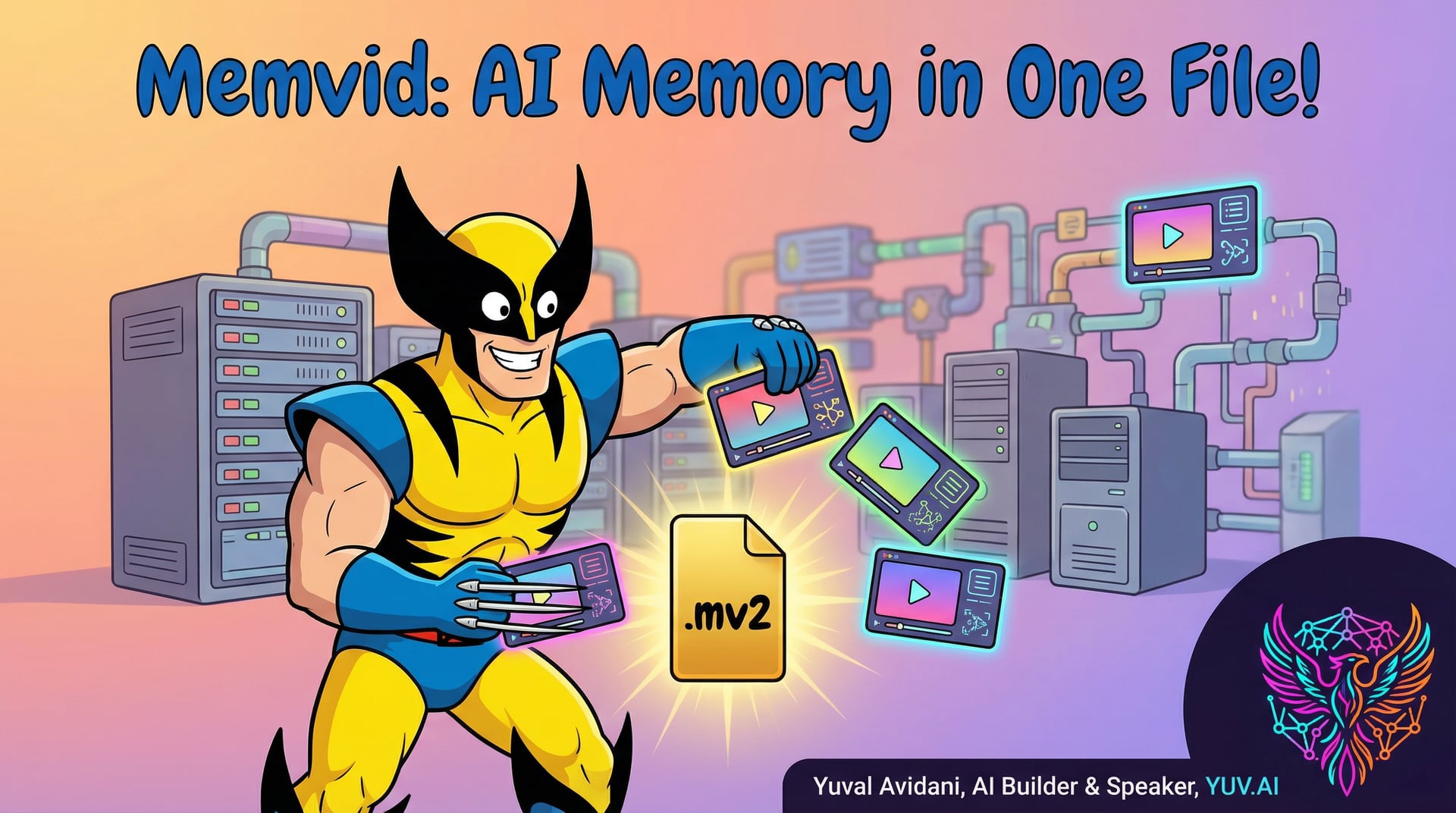
Memvid takes a completely different approach inspired by video files - hence the name. Instead of a database server, it creates a single .mv2 file that functions as a portable AI brain. Think of it like a save file in a video game: everything your agent knows, packaged into one file you can copy, share, or back up.
The system organizes memories as "Smart Frames" - discrete chunks of information appended to the file chronologically, similar to how video frames create a timeline. When your agent learns something new (a conversation, a document, a user preference), Memvid converts it into embeddings and writes a new frame to the .mv2 file. The file format includes built-in indexing structures that enable sub-5ms retrieval speeds, which is faster than most database queries despite being just a file on disk.
Here's the clever part: because memories are organized chronologically like video frames, Memvid supports "time-travel debugging." You can rewind to any point in your agent's history and see exactly what it knew at that moment. If your agent gave a weird response last Tuesday, you can inspect its memory state from that exact time to understand why. It's like having a DVR for your AI's thought process.
The architecture is completely serverless. There's no daemon running in the background, no ports to expose, no database to monitor. Your application just opens the .mv2 file, appends or queries memories, and closes it. For deployment, you can literally email the file to someone or commit it to a Git repository. The entire memory of your agent - conversations, learned facts, user context - travels as one portable artifact.
Real-World Use Cases
Customer Support Bot with Context: Imagine building a support agent that remembers every interaction with a customer across months. With traditional vector databases, you'd need to maintain a production database, handle user data privacy, and manage synchronization across deployments. With Memvid, you generate one .mv2 file per customer that lives alongside your application code. When the customer opens a support chat, you load their memory file and the agent instantly knows their entire history - previous issues, preferences, solutions that worked. When the conversation ends, you append the new interaction to their file. No servers, no database credentials, no infrastructure costs.
Research Assistant That Learns: Build an agent that helps with research by reading papers and remembering key findings. As you feed it PDFs and articles, Memvid creates Smart Frames containing the content and its embeddings. Later, when you ask "What did that paper say about transformer architectures?", the agent retrieves relevant frames in milliseconds. The entire knowledge base is a single file you can back up to Dropbox, version in Git, or share with colleagues. If someone asks "Why did the agent cite that specific paper?", you can time-travel back to see what information was in memory when that decision was made.
Why This Is Different from Pinecone/ChromaDB/Weaviate
Traditional vector databases are designed for massive scale - millions of users, billions of vectors, distributed across servers. That's overkill for most AI agent applications where you're building a single agent or one agent per user with thousands (not billions) of memories. Pinecone excels when you need cloud-scale infrastructure, but you pay for that capability even when you don't need it.
ChromaDB and similar embedded databases get closer - they run in-process without separate servers. But they still create database files with complex internal structures, require understanding of database concepts, and don't offer the time-travel debugging that Memvid provides.
You'd choose Pinecone or Weaviate when building a multi-tenant SaaS with thousands of users sharing a massive knowledge base that needs 99.99% uptime. You'd choose Memvid when building individual AI agents, prototyping quickly, or shipping applications where each user gets their own private memory. It's the difference between running a data center and carrying a notebook.
My Take - Should You Use This?
In my view, Memvid is a breakthrough for practical AI agent development. The single-file approach removes deployment headaches - no database servers to provision, no connection strings to secure, no scaling concerns for typical applications. The ability to version control an agent's memory in Git or email it as an artifact is genuinely novel and useful.
This is perfect for building personal AI assistants, research tools, customer-specific chatbots, or any application where you want each user/agent to have an isolated memory. The time-travel debugging feature alone makes it worth considering - being able to see exactly what your agent knew when it made a decision is invaluable for troubleshooting.
The limitation to watch: this approach works brilliantly up to a certain scale (thousands to tens of thousands of memories per agent), but if you need to store millions of vectors in a single memory file, traditional databases might perform better. Also, the .mv2 file needs to live on disk, so purely stateless serverless deployments (like AWS Lambda) require some adaptation.
Bottom line: if you're building AI agents and the complexity of vector databases has been holding you back, try Memvid. The simplicity is liberating, and the time-travel debugging is a feature you didn't know you needed until you have it.