
Yuval Avidani
Author
The Project That Makes GPU-Free AI Inference Actually Work
The project microsoft/BitNet solves the problem of running large language models (LLMs - the AI models that power ChatGPT-style applications) without needing expensive GPU hardware. For the first time, you can run models with 100 billion parameters on a regular laptop CPU and get decent performance.
Why this matters: Every developer building AI features today faces the same brutal tradeoff. Either you send user data to cloud APIs (expensive, privacy concerns, latency), or you try to run models locally (impossible without serious GPU hardware). BitNet breaks this constraint by making local inference actually practical on the hardware people already have.
The Problem We All Know Too Well
Let's be honest about the current state. You want to add an AI feature to your app - maybe a smart assistant, content generation, or code completion. Your options are limited and painful. Cloud APIs work but they cost money per request, they leak user data to third parties, and they fail when the internet drops. Running models locally sounds great until you realize that even a 7B parameter model (relatively small by today's standards) needs at least 14GB of GPU memory and chews through your battery in minutes.
We've tried quantization - the technique of reducing the precision of model weights from 32-bit or 16-bit floating-point numbers down to 8-bit or 4-bit integers. Tools like GGML and llama.cpp have made this practical. It helps - you can squeeze a 7B model into 4GB of RAM instead of 14GB. But you still need a decent GPU, the inference is still slow on CPUs, and anything beyond toy models remains out of reach for most developers. The fundamental bottleneck hasn't moved: running AI locally is still a specialized hardware problem.
How BitNet Actually Works
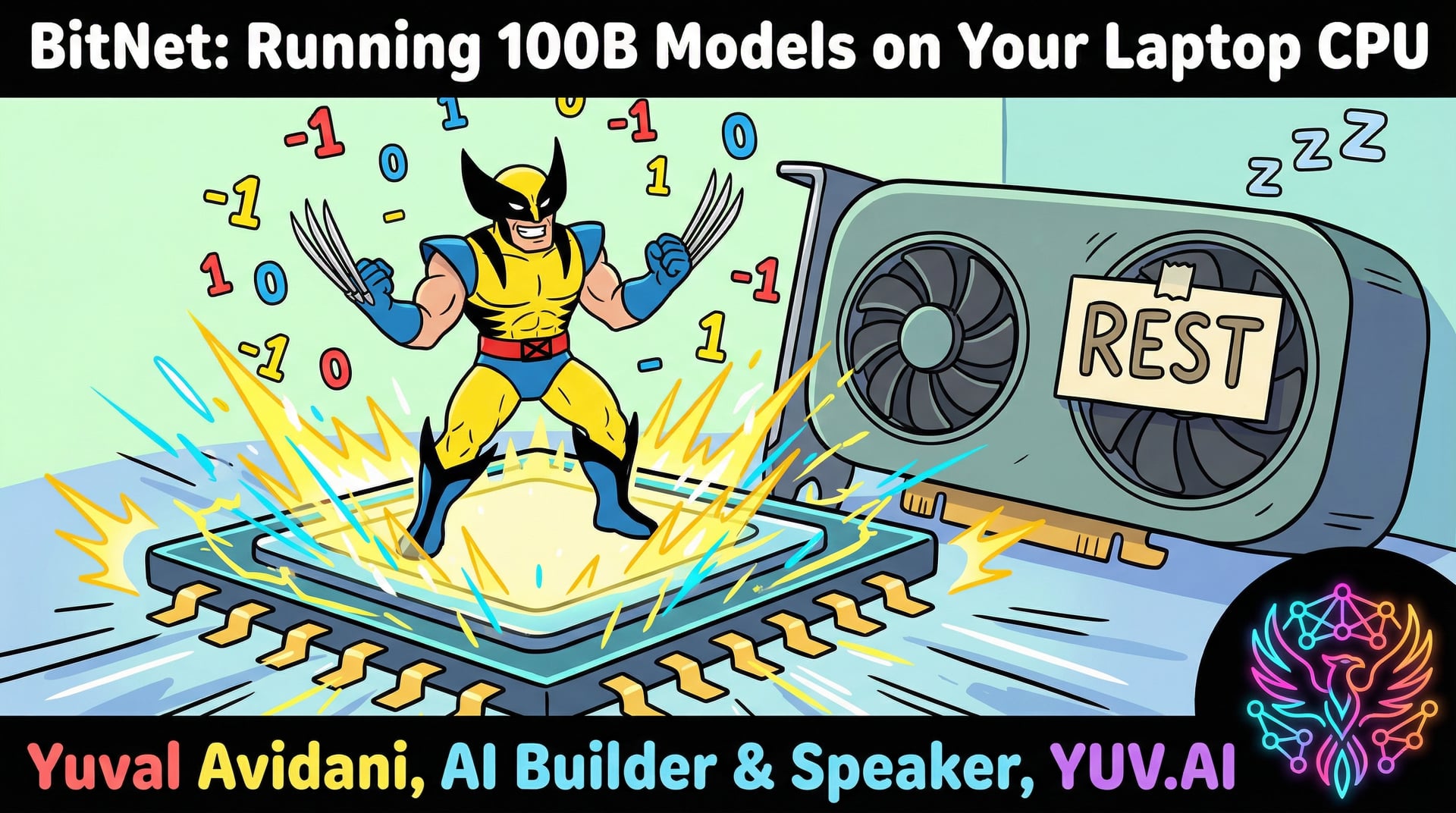
BitNet takes a radically different approach called 1-bit quantization. Instead of representing model weights as floating-point numbers (like 0.847362 or -0.234891), it uses only three values: -1, 0, and 1. That's it. Every weight in the entire neural network is one of these three numbers.
Here's the insight: Microsoft Research proved that you can train language models from scratch using this 1.58-bit representation (called BitNet b1.58 architecture) and maintain competitive performance with standard models. The term "1.58-bit" comes from information theory - since you're encoding three possible values, you need log2(3) = 1.58 bits per weight. Once you have a model trained this way, the inference (actually running the model to get predictions) becomes drastically more efficient.
Think of it like this: imagine you're doing a huge calculation that normally requires multiplying millions of decimal numbers. Now imagine the same calculation but you only multiply by -1, 0, or 1. Multiplying by -1 just flips the sign. Multiplying by 0 zeros things out. Multiplying by 1 does nothing. Your CPU can do these operations insanely fast compared to full floating-point math. That's the core trick.
BitNet provides optimized inference kernels (low-level code that runs these calculations) specifically designed for 1-bit models. These kernels run on regular CPUs - both x86 (Intel/AMD) and ARM (Apple Silicon, mobile processors). The framework achieves up to 6x faster inference speed compared to running quantized models with traditional methods, and it uses 82% less energy. They've demonstrated 100B parameter models running at usable speeds on laptop hardware without any GPU.
Real Use Cases Where This Changes Everything
Let's get concrete. Where would you actually use this?
Privacy-focused applications: Imagine you're building a medical app that analyzes patient notes or a legal tool that reviews contracts. You absolutely cannot send that data to OpenAI's API or any cloud service. With BitNet, you can ship a powerful LLM that runs entirely on the user's device. The data never leaves their machine. This wasn't practical before because you couldn't fit a capable model into consumer hardware constraints.
Edge computing and IoT: You're deploying AI on edge devices - maybe smart cameras doing video analysis, or industrial sensors that need to interpret readings. These devices don't have GPUs and often run on battery power. BitNet models can run on ARM processors with minimal energy draw. You can make real-time inferences locally without streaming data back to a datacenter. The 82% energy reduction matters enormously when you're running on battery or solar power.
Offline-first developer tools: Think about a code completion tool (like GitHub Copilot) that works when you're coding on a plane or in a remote location with no internet. Or a writing assistant that doesn't require a subscription to Claude or ChatGPT. You bundle a BitNet model with your application and it just works, no connectivity required, no API keys, no rate limits.
Why This Is Different from GGML, llama.cpp, and ONNX Runtime
You might be thinking: "We already have quantization tools. What's special here?"
Tools like llama.cpp and GGML do quantization down to 4-bit or even 2-bit, and they run on CPUs. The difference is the training paradigm. Those tools take models trained with normal floating-point precision and quantize them after training (post-training quantization - PTQ). You lose some accuracy, and the inference code still needs to handle various bit-widths and do frequent conversions. It's a compromise.
BitNet models are trained from scratch using 1.58-bit weights. The model learns to be effective within these constraints from day one (quantization-aware training - QAT). This means better accuracy at the same bit-width, and the inference kernels can be hyper-optimized because they only deal with three values ever. There's no mixed precision, no fallback to higher precision for certain layers, no compatibility matrix. It's architecturally cleaner.
ONNX Runtime and other inference engines are fantastic for running standard models efficiently, but they're still pushing floating-point math through CPUs or GPUs. BitNet's kernels are doing fundamentally different operations - mostly addition and sign flips instead of multiplication. That's why the speedup is so dramatic.
When would you choose something else? If you need to run existing pre-trained models (like Llama 2 or Mistral) right now, stick with llama.cpp or GGML. BitNet requires models specifically trained in the 1.58-bit format. Microsoft is releasing some, but the ecosystem is nascent. If you have GPU resources available, standard inference is still faster in absolute terms - BitNet's win is efficiency on CPU-only hardware.
My Take - Should You Use This?
In my opinion, BitNet is one of those projects that changes the conversation about where AI inference can happen. For years we've accepted that serious language models need GPUs. That constraint shaped everything - our architectures, our deployment strategies, our cost models. BitNet breaks that assumption.
If you're building anything where local inference matters - privacy-critical apps, offline tools, edge deployments, or products for users who can't afford cloud API costs - you should be testing this immediately. The efficiency numbers are not incremental. Running a 100B model on a laptop CPU was science fiction six months ago. Now it's a benchmark in this repo.
The limitations are real. You need models trained in the BitNet format. You can't just grab any HuggingFace model and plug it in. Microsoft is releasing trained models and the training code is open source, but the ecosystem needs time to mature. You'll need to evaluate whether 1.58-bit models meet your accuracy requirements for your specific use case - they're competitive but not identical to full-precision models.
But here's what excites me: the deployment story becomes radically simpler. No GPU orchestration, no autoscaling GPU clusters, no cold start delays, no per-token pricing anxiety. You ship the model with your app binary. It runs on whatever CPU your user has. That's it. For a whole category of applications, this unlocks possibilities that were economically or technically infeasible before.
Check out the repo and the benchmarks: microsoft/BitNet. If you're serious about local AI inference, this is the framework to study right now.